
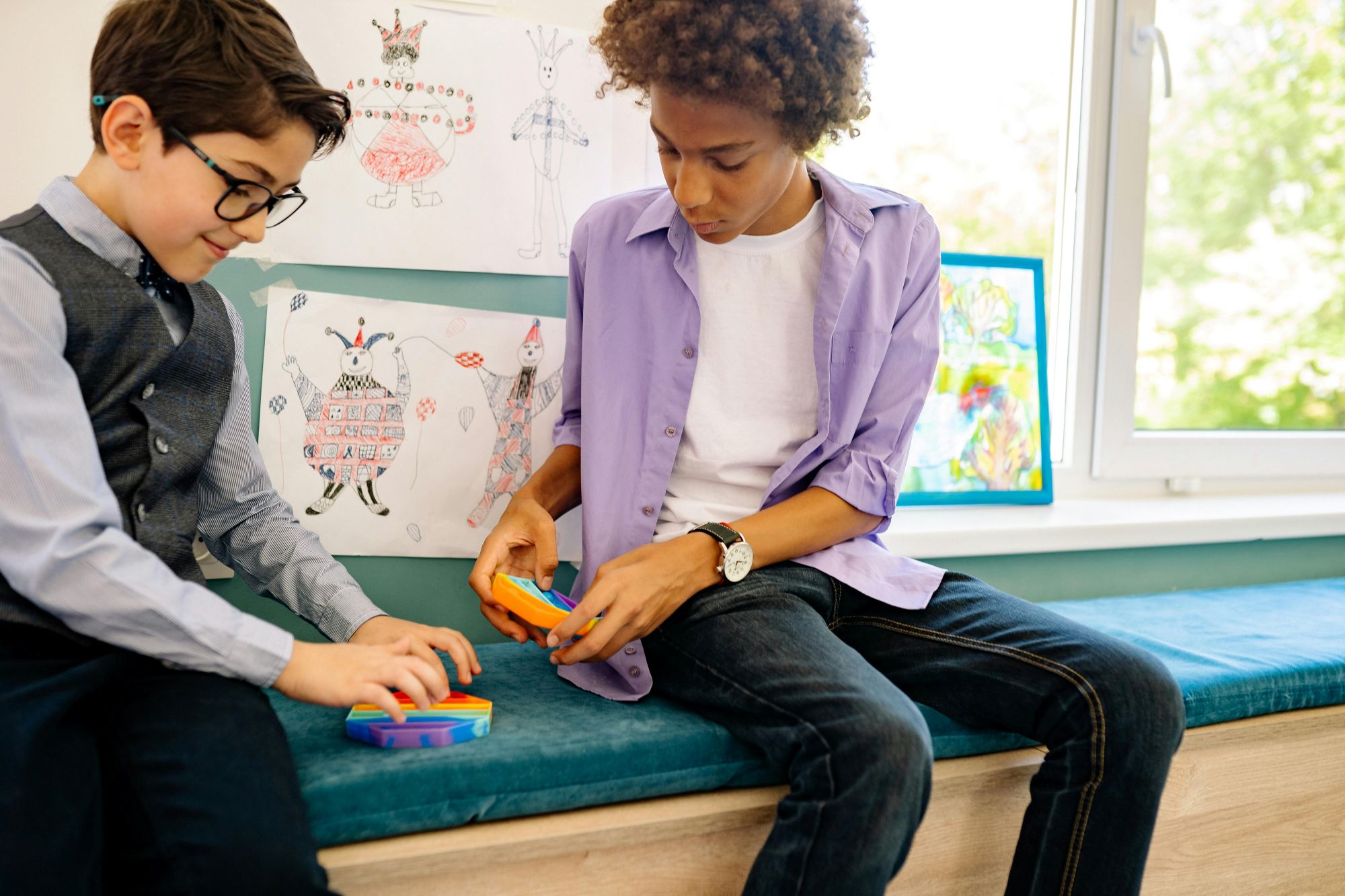
As a parent, I know the thoughts that come: Not another toy–how long will this one last before they ask for another to clutter up the house?
Pause with me: I’d like other Gen X and Millennial parents to recall the click-y pens, textbook doodling, and pencil-spinning stunts of our childhood. Or how adults squeeze stress balls and pop bubble wrap and play with jacket zippers. How, perhaps, watching the leaves dance in the wind through a window can get our heart rate and breathing to slow down so that our brains can think instead of panicking.
The research is showing that fidget toys benefit us through 3 mechanisms: sensory regulation, cognitive redirection, and neurological effects:
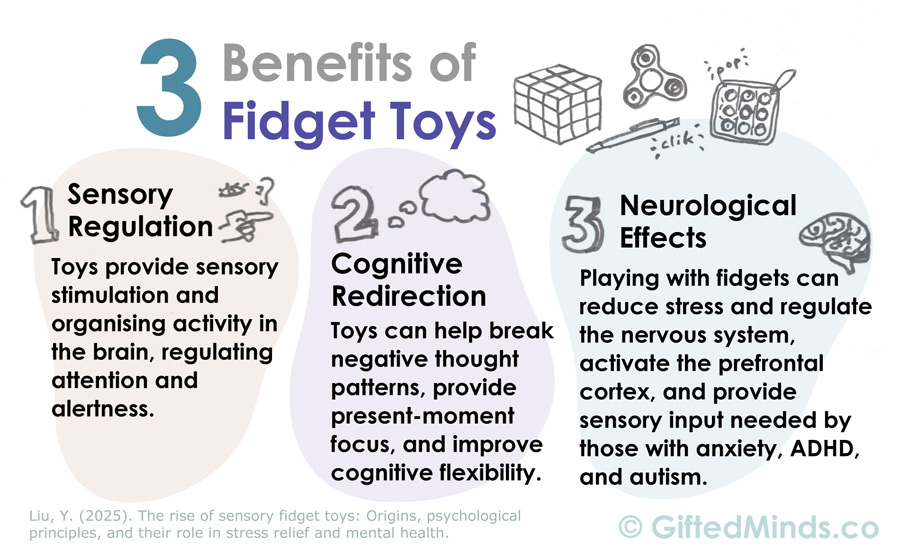
Fidget toys usually have sensory features (squishiness, “click-iness”, fast or slow movement) that don’t take a lot of effort to enjoy. Interacting with them engages our brains in the here-and-now, a mental tool that can help us not spin off into dysregulation or rumination. And, some brains just seem to need them:
A person who can’t get up and walk around to wake up a bit, or go have a nice cup of tea to calm down, may find it helpful to use a fidget item to get in the right frame of mind to stay focused and calm while staying put. (Source)
Research has found fidget toys to be even more beneficial in cases of neurodivergence, like autism and ADD/ADHD. Because people with ADHD and autism typically struggle with sensory processing and emotional regulation due to heightened sensitivity to sensory input, feelings of anxiety and overwhelm are very common. For this reason, fidget toys can be particularly effective in redirecting feelings of overwhelm and providing calming sensory input for these individuals. (Source)
Types of Fidget Toys and How to Choose
Fidget toys don’t just look like fidget spinners, which were the bane of countless classroom teachers upon a time. There are fidget toys that demand our eyes to work, and others that don’t. It can take trying different toys to find one that fits an individual and the situation.
Consider the qualities of different toys that will appeal to different preferences and needs:
- Shape and size: If it is small and unobtrusive, or larger and fills the hand
- Texture and tactile features: Smooth, rough, hard, soft, pliable, fuzzy, slimy, or sticky
- Sound effects: Clicks, “zips,” pops, or no sound at all
- Type of moment: Slow, fast, spinning, springing, pressing, or popping
- Resistance/weight (providing “heavy work” for hands and a grounding effect for emotional regulation)
- Color, pattern, visual appeal and complexity
- If it needs to be visually tracked by the eyes to work or can work purely by feel
And the toys that exist for these different tastes so far include:
- Fidget spinners
- Fidget cubes
- Fidget poppers
- Fidget magnets
- Fidget tangles
- Magnetic ball bearings
- Slime
- Kneadable erasers (quiet and recommended for classrooms)
- Clay and poster putty
- Stress balls
- Stretchy worms
- Squishy toys
- Taba Squishies
- Slinkies
- And probably more that I missed…
Cost-wise, fidget toys are on the lower end of the scale. A child, adolescent, or even an adult cycling through a collection of fidget toys isn’t out of the ordinary; A family might even benefit from having an easily accessible basket of these in a common space.
As brain benefits go, we know that humans crave cognitive and sensory stimulation for brain development–fidget toys serve this need without being too cognitively demanding.
So, go ahead, get that toy! It’s therapist-approved.